Assisted reproduction therapies
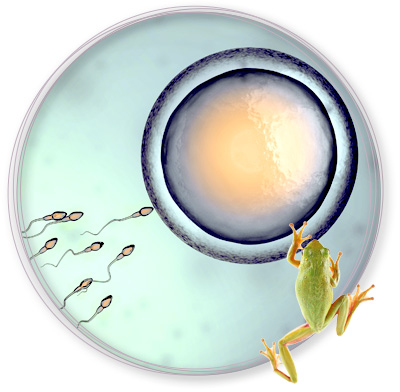
In IVF (in vitro fertilisation), the sperm cell enters the egg cell by itself.
Fertilisation occurs in a culture dish of its own accord.
The therapies using the assisted reproduction technique (ART) aim at the egg and sperm cell combining outside the body of the woman. They are then inserted if it is impossible to provide support for natural conception or the natural conception therapies are unsuccessful.
Egg cells are fertilised with sperm cells outside the body and transferred back into the uterine cavity a few days later. The implantation for pregnancy takes place there.
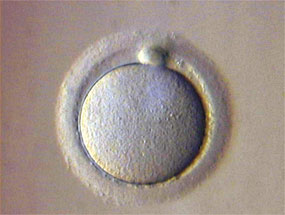
Stadium Metaphase II
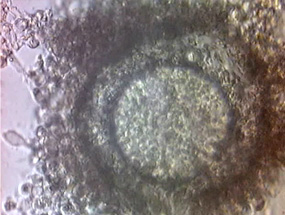

The retrieval of the egg cells is preceded by hormone stimulation over a period of approximately two to three weeks. Several egg cells mature in this way. The time of the retrieval of the egg cells is programmed. The preparation of the sperm serves to isolate sperm cells with good
mobility, as only these are brought together with the egg cells in the culture dish.
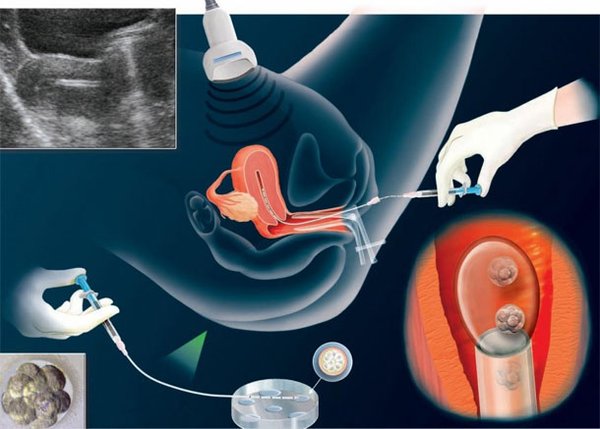
The egg cells are retrieved through the vagina with a thin aspiration cannula under ultrasound monitoring. This generally takes place under light sedation. The egg cell is fertilised within a few hours.
Then comes the cell division of the egg cell; the embryo develops. The transfer of the embryo into the uterine cavity generally takes place after five days. The transfer takes place through the vagina and the mouth of the uterus by means of a thin cavity and is completely painless.
Stimulation / egg cell retrieval / sperm preparation
fertilisation / embryo transfer / luteal phase
Stimulation
With a few exceptions, in which the egg cells can be retrieved in a spontaneous cycle, most IVF treatments take place with hormone stimulation. The hormone treatment leads to more than one egg cell maturing in the ovaries. With corresponding ultrasound monitoring, the time of the retrieval of the egg cells (follicle puncture) can be planned in a targeted manner.
-
Types of stimulation treatment
I. Medium length protocol - “downregulation”
Six days after the ovulation of the preceding cycle (on the 20th day of the cycle in a 28-day cycle), what is known as downregulation starts, i.e. the suppression of the pituitary hormones LH and FSH, e.g. by the daily administration of a nasal spray (Synarela®).
The nasal spray leads to the immobilisation of the pituitary glands and thus prevents premature ovulation.
Hormone stimulation of the ovaries with daily subcutaneous injections (Puregon®, Gonal F® or Menogon HP®) start on the 4th day of the following cycle, whilst continuing to administer the nasal spray.
The stimulation lasts for approximately ten days. During this period, three to four ultrasound examinations and blood tests take place.
With a follicle size of 20 mm, the time of ovulation is fixed at 36 hours after the treatment, at 23:00 at night, due to the hormone which is injected subcutaneously. The retrieval of the egg cells takes place on the morning of the second day between 09:00 and 11:00.II. Short “antagonist” protocol:
<EM/>Stimulation begins on the 3rd day of the cycle with daily subcutaneous injections. With this form of stimulation, the additional administration of a nasal spray is not necessary. On the 7th day of the cycle, the first ultrasound examination is performed. With a follicle size of 14 mm, the hormone Cetrotide or Orgalutran is injected in addition to the daily stimulation hormones, which can prevent a premature ovulation until its hormonal programming. (Cetrotide® and Orgalutran® are LH antagonists). The programming takes place just as in the downregulation protocol.
Egg cell retrieval for IVF / ICSI
The egg cells are retrieved by transvaginal follicle puncture under ultrasound monitoring: a thin aspiration cannula is fed into the ovary’s follicles through the lining of the vagina. Through careful aspiration, the egg cell is retrieved directly from the follicular fluid. This procedure is repeated with each follicle and lasts five to ten minutes in total.
-
Technique
The ejaculate is mixed with a special liquid (cell culture medium) and the mixture is centrifuged until only cellular components of the ejaculate are concentrated in the sediment. The supernatant is discarded and some cell culture medium is layered on top of the sediment. Moving sperm actively swim out of the sediment into the covering layer of cell culture medium. 100,000 sperm are used to fertilise the egg cell.
-
2. Fertilisation
In the course of an hour, a single sperm enters the egg cell. The fertilisation process has begun.
After 18 hours, a diagnosis can be made about the pronuclei with the female or male set of chromosomes in the egg cell. Fertilisation has completed.3. Cell division
- After 24 hours, the egg cell has developed into a two-cell embryo
- After 48 hours, it is a four-cell embryo
- After 72 hours comes the eight-cell embryo
- After approx. 120 hours, the blastocysts are formed
-
Technique
One or two embryo cells (in rare cases three) are drawn into a thin soft catheter and transferred through the vagina and the mouth of the uterus into the uterine cavity. The embryo transfer happens when the patient is lying down and is painless. After a half-hour rest period, the treatment is complete.
-
As a pregnancy can be verified on the 11th day after the egg cell retrieval, the pregnancy hormone HCG is identified on the 11th and 14th day.
In the event of a successful pregnancy, we perform the first ultrasound 21 days after the egg cell retrieval. The size of the amniotic sac in the uterus is now approximately five millimetres.
The second ultrasound examination takes place 30 days after the egg cell retrieval. Now, a five millimetre embryo with a heartbeat can be seen.